STELLAROrbital computing
Node-2 / Planned / Mission 2

Node-2: Commercial edge compute in orbit

Node-2 expands from validation to service capability with scheduled customer workloads, persistent orbital storage, higher compute density, and automated delivery workflows.
Scheduled
Service mode
Customer jobs
Primary proof
Compute density
Advances
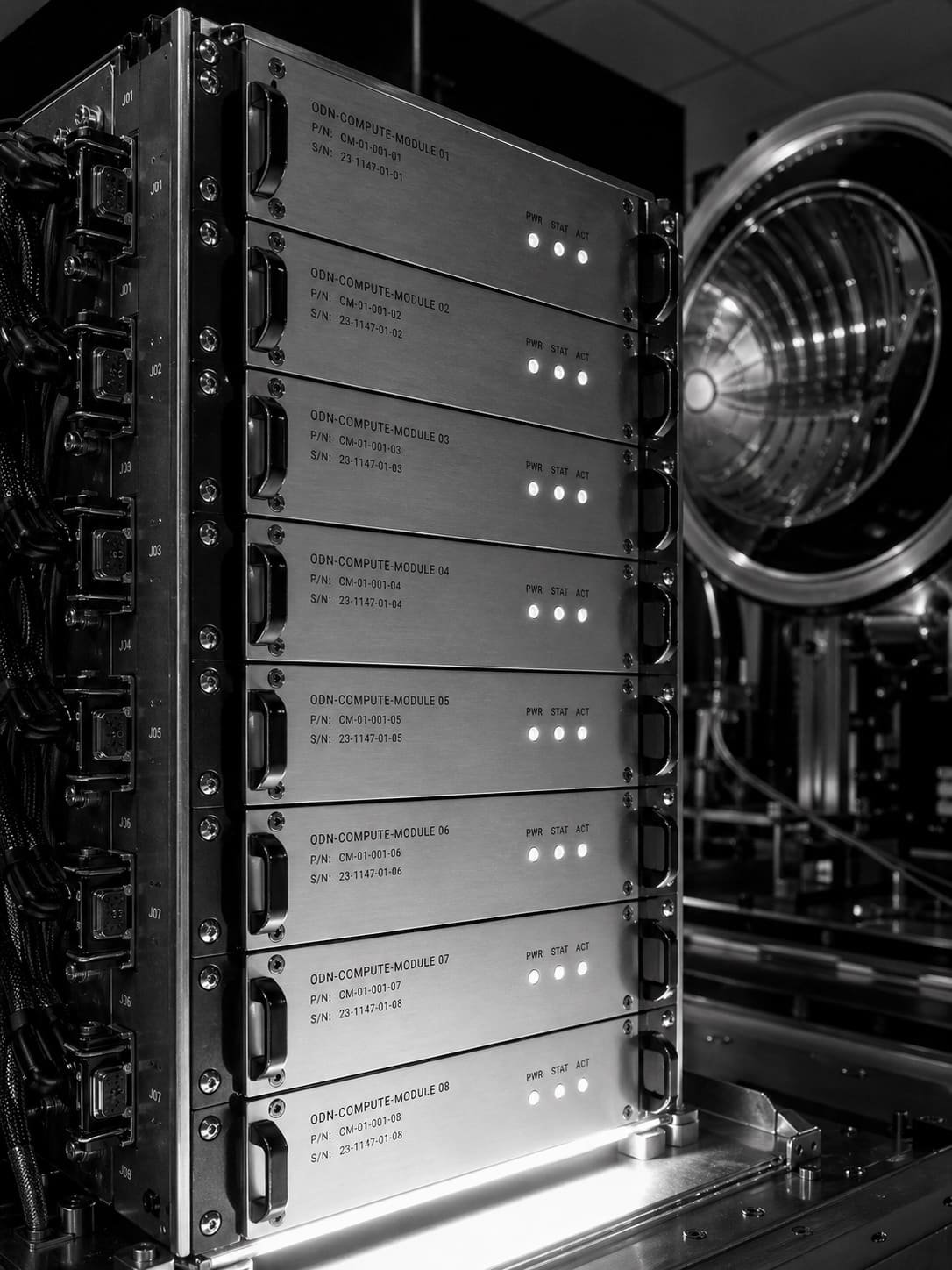
Node-2/ visual
Orbital data-center compute payload module
From payload validation to early commercial service.

The first commercial STELLAR node. Higher compute density, scheduled customer service windows, automated delivery with receipts. Demo workloads become paid workloads.

01 / mission narrative

Why this mission, and what it must prove

Move from engineering demonstration to early commercial workloads with a stronger compute module and repeatable service operations.

01 / From proof to product

The compute envelope grows; the operations envelope tightens

Node-1 proves the foundation. Node-2 turns it into a product. Compute density increases through a denser FPGA + GPU coprocessor configuration; storage capacity steps up to support customer datasets; scheduled service windows replace demo executions; and delivery is automated end-to-end so STELLAR can take a customer job at 09:00 and return a receipt-bearing result before the next pass.

02 / Service contract

Commercial means SLAs

Node-2 introduces the first formal customer service contract: scheduled execution windows, priority classes, delivery deadlines, integrity guarantees, and replayable evidence. The same operations console and customer API used since GroundLab now carry SLA semantics. Customers can subscribe to a window class instead of asking for a one-off run.

03 / Why this is hard

Predictable compute under unpredictable physics

A scheduled service window only holds if power, thermal, and contact stay inside their envelopes. Node-2’s scheduler models all three jointly solar generation, eclipse, battery state, radiator hot-case, and pass timing and offers windows the spacecraft can actually keep. When margins narrow, lower-priority classes degrade gracefully instead of breaching SLAs.

02 / mission profile

Orbit, payload, power, thermal, comms, partners

The profile is the mission’s physical truth every architectural choice descends from these numbers.

Orbit
500–550 km mid-inclination orbit
Altitude
500–550 km
Inclination
~55° (TBD per launch)
Operational duration
24-month operational window
Payload class
Dedicated module 180 kg allocation
Power envelope
1.6 kW peak / 880 W average
Thermal envelope
1.4 kW peak heat rejection
Contact window
8–14 passes/day across multiple ground sites
Primary partners
Spacecraft prime (Node-2 carrier) · Compute coprocessor vendor (radiation-tolerant GPU) · Multi-site ground network · Three to five paying mission customers
03 / technical architecture

Systems that must work as one

The mission is the sum of these subsystems and the way they constrain each other.

SystemSpecificationDesign note
Compute fabricFPGA + radiation-tolerant GPU coprocessor (~120 TOPS)Adds a coprocessor lane for higher-throughput AI inference and larger-batch image processing while preserving the deterministic FPGA path for autonomy workloads.
Management CPUQuad-redundant GR740 clusterWorkload scheduler, customer-API gateway, FDIR, telemetry mux. Dual-string software with cross-channel checkpointing.
Storage path8 TB hot pool + 32 TB persistent pool + 256 GB priority queueCustomer datasets persist across passes. Priority queue ranks delivery against contact windows, customer SLAs, and mission-safe thermal constraints.
ThermalLarger deployable radiators + active loop controlActive thermal control adjusts loop flow against compute load profile. Hot-case capacity sized for sustained 1.4 kW rejection at end-of-life.
CommsX-band downlink + dual S-band TT&C, multi-site groundMulti-pass delivery across two or three ground sites narrows the gap between job submission and customer receipt to under 4 hours typical.
Service contractSLA-backed scheduling, priority classes, replayable receiptsAPI contract gains scheduling primitives (window-class subscription, deadline guarantees) and integrity primitives (signed receipts, replay log).
04 / capabilities added

What this mission adds to the roadmap

Each mission is justified by a specific new capability not just a larger payload.

Capability 01

Scheduled customer workload execution windows

Capability 02

Persistent orbital storage with priority downlink rules

Capability 03

Automated job receipt, execution, and delivery workflow

Capability 04

Higher thermal and power envelope for more useful compute density

Capability 05

Multi-pass delivery reconciliation across multiple ground sites

Capability 06

Service-level priority classes with graceful degradation

05 / phased plan

Mission timeline milestones, not vibes

The plan is broken into reviewable phases. Each phase ends in a deliverable a stakeholder can read.

Phase 0Concurrent with Node-1 ops
Service contract drafted

Scheduling primitives, SLA classes, evidence guarantees specified with three to five design-partner customers.

Phase 1~Node-1 +12 months
PDR

Compute coprocessor integration, scheduler architecture, and service-contract review.

Phase 2~Node-1 +24 months
CDR + qualification

Full vibration / TVAC / TID qualification of the coprocessor + thermal stack.

Phase 3~Node-1 +30 months
Launch + commissioning

Commissioning campaign scheduler validation, ground-cloud SLA loop, first paid customer window.

Phase 424-month nominal window
Operational service

Steady-state commercial operations. Telemetry feeds Node-3 cluster planning.

06 / risk register

What is closed, mitigated, in design, or open

A serious mission tracks risks honestly. Closed, mitigated, in design, and open items are listed without softening.

RiskStateDescription
GPU coprocessor SEU rate at design altitudeIn designTotal Ionizing Dose and Single-Event Upset rates at 500–550 km mid-inclination drive coprocessor selection and shielding strategy.
SLA breach under thermal hot caseIn designScheduler must demote priority classes before breaching SLAs. Validated through orbit-condition replay against the GroundLab twin.
Multi-site ground reconciliationMitigatedReceipts are signed and replay-safe; ground-cloud reconciliation closes when all-of-N signatures present. Tested in Node-1 telemetry.
Customer concentration riskOpenNode-2 is sold to a small number of design partners. Diversification is a Node-3 commercial gate, not Node-2.
07 / verification

Every claim ties to an evidence product

The right way to read a mission page: claim → evidence → state. If a row is in the wrong state, the page is what is broken not the program.

ClaimEvidenceState
Scheduler delivers contracted SLA classes under nominal thermal/power state.On-orbit scheduler logs reconciled against GroundLab predictionsPlanned
Coprocessor maintains predictable throughput under design SEU rate.TID + heavy-ion radiation testing + on-orbit performance logPlanned
Customer job → result median latency under 4 hours.Multi-site ground reconciliation telemetry, 90-day campaignPlanned
Hot-case radiator capacity sustains 1.4 kW rejection at EOL.Thermal correlation + on-orbit telemetryDraft
From payload validation to early commercial service.
Advancement
Node-2
Stage
Planned
Program state
09 / continuity

What this mission inherits, what it enables

Each mission is a step on a single staircase. These bridges spell out what comes from the prior step and what becomes possible after.

Roadmap / index

All STELLAR missions

Open roadmap

Continue to Node-3: Orbital Cluster

Node-2 builds on Node-1 by moving from "From ground simulation to hosted orbital payload." toward "From payload validation to early commercial service.".