
A mission roadmap for orbital data infrastructure

Each mission retires a harder technical risk
The mission ladder moves from executable digital twin, SIL rehearsal, interface emulation, and Monte Carlo assurance campaigns to hosted payload proof, then customer service, multi-node operation, sovereign infrastructure, and mesh-scale cloud services.
GroundLab
GroundLab validates the software, thermal, workload, storage, comms, security, and operations models before flight hardware is committed. It is the program’s permanent executable twin and mission rehearsal environment.
Pathfinder Payload
Node-1 validates the foundation: spacecraft interfaces, compute payload operation, resilient storage, thermal duty cycles, downlink delivery, and mission operations.
Edge Compute Node
Node-2 expands from validation to service capability with scheduled customer workloads, persistent orbital storage, higher compute density, and automated delivery workflows.
Orbital Cluster
Node-3 introduces multi-node operations: workload distribution, node-to-node replication, failover, and orbital resource scheduling across more than one data-center asset.
Sovereign Orbital Region
Node-4 introduces isolated orbital service regions for customers that require resilient, physically separated, jurisdiction-aware infrastructure for sensitive compute and protected data.
STELLAR Mesh
Node-5 is the target architecture: a distributed orbital data-center network combining compute fabric, storage fabric, optical relay, autonomous operations, and ground-cloud interoperability.
Node-1 is the first orbital payload gate after GroundLab
GroundLab proves the mission-control loop in software. Node-1 then validates the practical boundary between spacecraft services and data-center payload behavior in orbit.
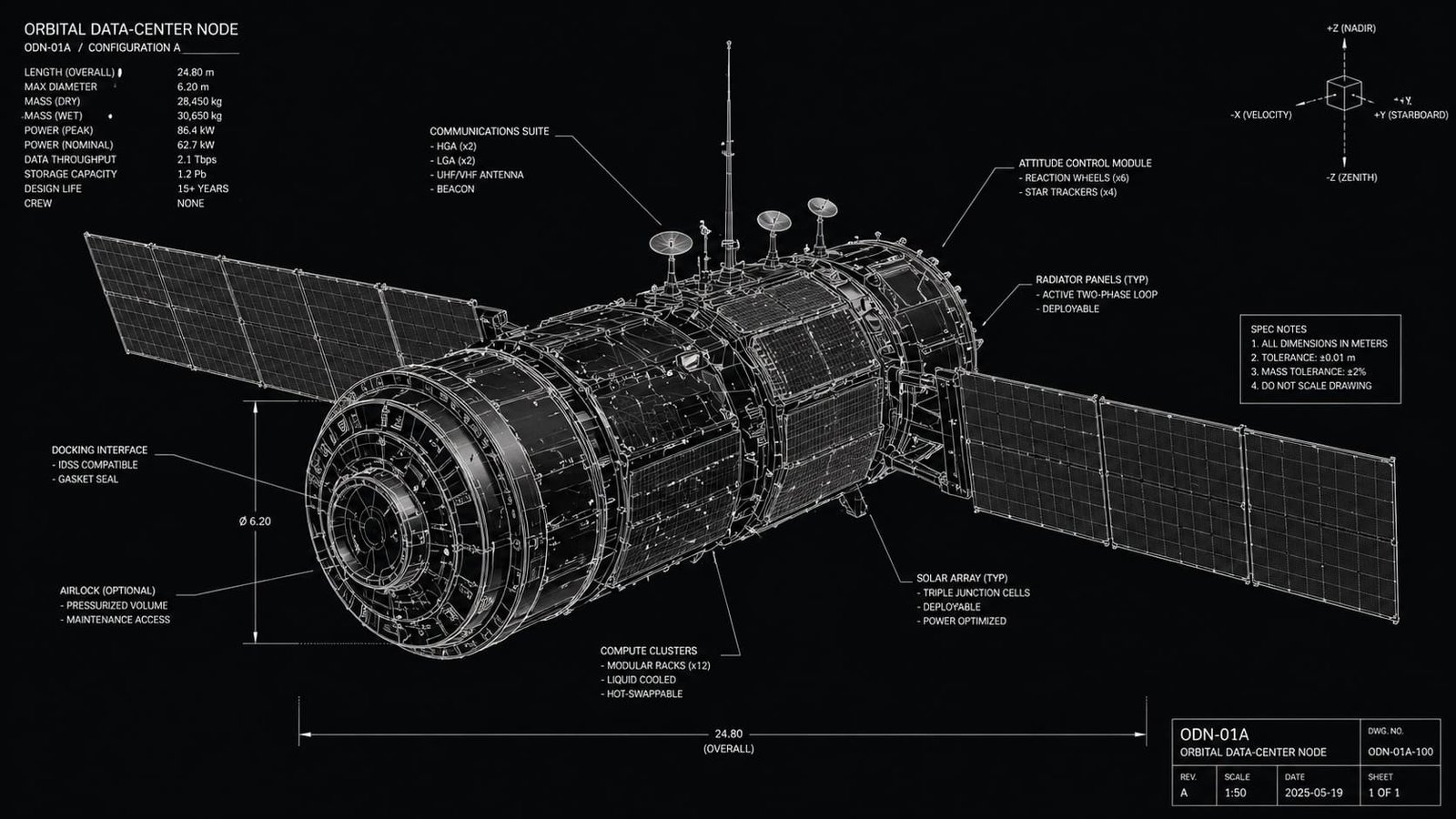
The first STELLAR payload in space. Hosted on a partner spacecraft. Designed to prove that compute and storage can be operated as a mission service inside real orbital limits.
- Orbit500 km sun-synchronous orbit (10:30 LTAN)
- Altitude500 km
- Inclination97.4°
- Duration12-month nominal operational window
- Payload classHosted payload 95 kg allocation
- Power envelope950 W peak / 480 W average from host bus
- Thermal envelope838 W peak heat rejection / 1,200 W radiator capacity
- Contact window42–55 min/day X-band, 100–500 Mbps class
- Hosted payload interface with spacecraft bus services
- Radiation-aware compute path with checkpoint and restart behavior
- Resilient storage queue with integrity checks and delivery receipts
- Thermal duty-cycle management tied to orbit, power, and radiator capacity
- Operator-authorized tasking and scheduling from ground
- End-to-end customer demo workload submit, execute, deliver